The Culmination of Another School Year

Woah! My district has 7 official school days left. But, the end of the school year has been a whirlwind! There are so many events both inside of school and after school! I don’t know if I’m coming or going!

Though the end of the year breeds chaos (organized chaos, mostly!), I always wonder the following at this crazy time:

  • It’s essential that we as teachers and teacher leaders continue learning and developing our craft. For many, summer is the best time for that continued professional development.
    • How do you encourage your staff/team to engage in professional learning during the summer?
  • What are some ways you celebrate the culmination of another school year (both with staff and students)?
    • I’m not saying learning should stop. But, I am saying that it’s essential to look back on the year, dialogue about goals met/not met, celebrate successes, analyze failures or obstacles, and plan for the future.
  • Some teachers take summer very seriously (for good reason). I’ve heard about some in the field of education who don’t check the work email for an entire three months!
    • How do you tactfully connect with your team over the summer (so as to not invade privacy or disturb their time with family)?
  • As leaders, it’s also important for us to take a step back and relax over the summer. I’m not very good at maintaining that work/life balance.
    • How do you disconnect and recharge over the summer?

Like/Comment/Share! I’d love to hear from you!

Reintegration: Essential for Schools AND the Real World Post Education

Historically, human justice systems have generally encompassed four main tenants of punishment: retribution, rehabilitation, deterrence, and incapacitation. Retribution refers to the idea of the punishment for a crime being proportionate to the harm caused by the offender. Rehabilitation, which is preventative in nature, supposes the offender requires some type of treatment or intervention to improve the mind and body. Ideally, deterrence uses punishment to dissuade potential offenders from choosing crime to begin with. Incapacitation refers to the possible permanent removal of an offender from society who is deemed too threatening.

It’s no secret. Crime results in offenders experiencing stigmatization. With crime, offenders often spend the rest of their lives with the stigma of being a criminal. In addition to experiencing this stigmatization, offenders are often then subject to other societal disadvantages (loss of the right to vote/difficulty finding gainful employment/constant stereotyping/etc.). If you work in a school, you may notice that this experience is not all that dissimilar to that of our students who exhibit behavioral issues. Our “problem kids/bad kids/behavior problems” (whatever you want to call them) are often stigmatized after exhibiting behavior problems in the classroom or in the school, and may be labeled as such. Considering that our self-identity is immensely impacted by how others view or label us, Lents and Kazemian (2017) state:

Individuals form their self-identity on the basis of how they perceive others to view them… Once individuals are marked by a deviant label (ex. Offender), this label reinforces their feeling of being an “outsider,” alienating them… The resulting loss of status weakens the desire to conform to social norms, and thus leads to further deviance… As the label reinforces the identity, the negative identity, in turn, reinforces deviance. (p. 15)

Thus, labels carry burdensome weight, and it would appear that these offenders who have been labeled, also feel alienated and are less motivated to even try to prevent future offenses or reintegrate back into society. The negative identity associated with the label is reinforced after an offender has been labeled and faces obstacles to reintegration.

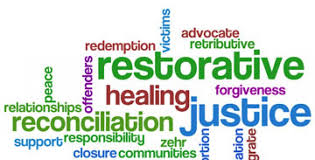
When I think about this in the context of schools, I recall “restorative justice” practices. Though I’m not an expert in this area, I like to think that I employ aspects of restorative practices, such as encouraging the repair of harm caused by misbehavior, mediating cooperative and reflective practices and dialogue that lead to relationship rebuilding, and reintegration as I invite students back into the school community. I need and want them to be contributing members of our school society.

The focus of any justice system should be on that system’s positive effects, such as how well the system prevents “reoffending” or “recidivism.” Research has shown that systems that focus on retribution, deterrence, control, and incapacitation are highly ineffective at reducing reoffending. In fact, not only have fear-based interventions been ineffective at reducing recidivism, research has found that they may actually contribute to the problem. However, systems that capitalize on human beings’ innate desire to reintegrate into society and culture are more successful at reducing recidivism.

Knowing what we know about criminal justice systems, if we don’t work to reintegrate students after they’ve served consequences/done their time/whatever you want to call it, aren’t we just exacerbating the problem? If students remain stigmatized and see no point in reintegrating into the school society/culture, aren’t we perpetuating a system that does more harm than good?

Like/Comment/Share! I’d love to hear from you!

Walk Out or Walk Up: Quit the Divisive Rhetoric and Celebrate the Students

As I’m sure you’re all aware, many students across the nation participated in a Walk Out on March 14th in order to protest government inaction regarding gun control. I’ve seen news coverage of the story across the U.S. I got the chills when I heard some of the student activists speak on the matter. Overall, I was impressed by the demeanor with which many students approached this highly controversial, yet extremely timely and important topic.

Then, I noticed another budding movement on Twitter. I first saw a picture on my feed advertising a “Walk Up.” I immediately became intrigued and conducted further research. This “Walk Up” focused on walking up to other students and being kind in an effort to create better/safer school environments. To me, this completely made sense. The way I see it, in all honesty, regardless of any protests held on a myriad of school-related issues/policies, there will always be students who are ostracized or cast out or alone in every school. Thus, I really gravitated toward this movement, as it seemed to focus more on an issue over which we in education actually have control: being kind and reintegrating students who may be lost or ostracized.

Unfortunately, in regards to both movements, a politically motivated, dichotomous dynamic has presented itself. It seems that adults have successfully oversimplified and debased both ideas/movements to either gun control related or mental health related. People have declared that Walking Out won’t help because it won’t address the heart of the problem: poor school environments and students feeling isolated. People have decried that Walking Up won’t help because it won’t address the heart of the problem: guns. The debate has raged on in the Twitterverse for over a week now.

Whether Walking Out or Walking Up, I think it’s important that as adults, we celebrate the students’ courage, leadership, determination, organization, social awareness, creativity, passion, fortitude, and unity (among other qualities). Granted, some adults are celebrating these efforts. But, I think it’s important to remember: rather than distracting from the students’ achievements by hijacking the foci of these movements, we should acknowledge that Walking Out or Walking Up requires strength and perseverance. I truly believe these students, whether they Walk Out or Walk Up, are striving to make changes in a world where, unfortunately, children have been dying in the one place where they should be the safest.

Also, I mean, does it really have to be so two-sided? Honestly, can’t schools/students engage in both a Walk Out AND a Walk Up? Obviously, the national Walk Out was held March 14th. The Walk Up sounds like an ongoing endeavor.

Let me know what you think!

Like/Comment/Share!

Distributive Leadership: Why It’s Essential in Schools and Districts

We all have different leadership styles. Some leaders employ a transactional leadership style that is very business-oriented, where goods and/or services are exchanged for money (paycheck). Some leaders utilize a bureaucratic leadership style by ensuring people follow the rules and always complete tasks by the book. Other leaders may use a laissez-faire leadership style where the workplace is characterized by a “let them do/let it be” or “hands-off” approach. Others embrace a transformational style that inspires staff through effective communication strategies and helps create an intellectually stimulating environment. There are numerous more leadership styles. I’ve seen entire books dedicated to defining each leadership style, and then proclaiming to help individuals develop the style that best suits them.

Whatever your leadership style or take on leadership itself, I believe that if we conceptualize leadership as being confined only to those in “leadership” or “authority” roles, not only are we overlooking the potential leaders and leadership capabilities of the many people within our buildings, we are overburdening ourselves as administrators and teachers. It’s no secret. We can’t do it all. And, to be honest, we shouldn’t have to. Like the old adages say, “two heads are better than one” or “it takes a village.” When optimal conditions exist (minimize opportunities for group think, norms for collaboration have been established and modeled, a clear purpose has been established, people are working together for the betterment of children, etc.) the more people working together collaboratively to generate solutions, the better.

I’ve heard of democratic leadership and shared leadership styles that encourage teams to share ideas and input together before making a final decision. I utilize these approaches daily. But, recently, I read about Distributive Leadership. Distributive leadership emphasizes maximizing leadership expertise at all levels to build widespread capacity throughout an organization. It also holds that no one person at the top makes all the decisions. For example, in schools, teachers are empowered to run/operate crucial aspects of a school, such as admissions, scheduling, professional development, and new teacher training and mentoring. Research suggests that one of the main differences between high performing and low performing schools is often attributed to varying degrees of leadership distribution. High performing schools often distribute leadership widely throughout the building.

Personally, I like its focus on interdependent interaction, ownership, and empowerment. I believe teachers should be empowered and encouraged to make the decisions that will impact them and their students most. As a leader, it’s my job to listen to my teachers and include them as we endeavor to improve all our practices. Most importantly, I must trust my teachers and not shy away at the first sign of bumps in the road.

What leadership style do you employ? What leadership style does your administration/manager/boss/etc. utilize? What leadership style do you think works best? Under what leadership style would you enjoy working most?

Like/Comment/Share!