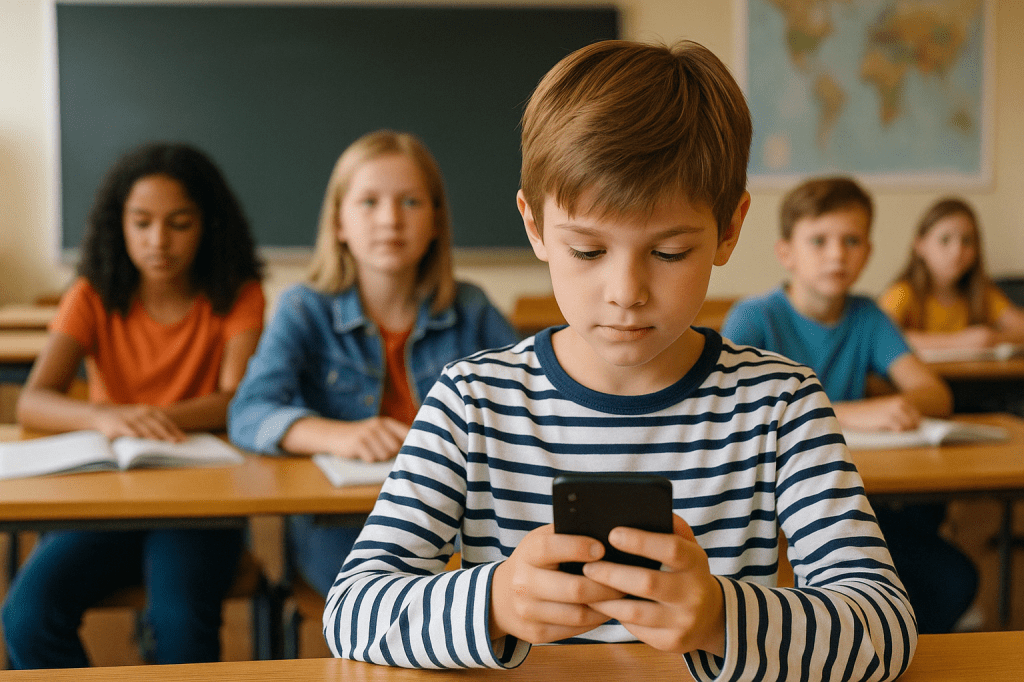
Kids Don’t Need Facts. They Can Google That Stuff Later…


It was the year 2008. I got my first “smartphone” (a Samsung). I couldn’t believe I (and everyone else with a smartphone for that matter) had the internet (and social media) at my fingertips! What a momentous occasion! Around the same time, I also started substitute teaching. In 2007, I graduated from ISU with a degree in Communication. I didn’t like where I was working or what I was doing (a marketing job in the city). So, I started subbing to make extra money and ended up LOVING it. 

When I got my own classroom, technology and phones were even smarter (and more affordable)! My students started getting their own smartphones (most of the time, their phones were better and smarter than mine!). Educators began contemplating how to incorporate smartphones into the classroom/learning. In addition to the 1-1 initiatives some districts were implementing, educators embraced a more financially friendly trend: Bring Your Own Device (BYOD). If districts/schools allowed it, students used their own devices for learning and research purposes while in class.

This trend was the impetus for a new and popular idea for learning: “Kids don’t need to know facts/dates/names/etc. They can just google that stuff later.” For many educators, this idea just made sense. Some saw this as a way to maximize learning efficiency in their classrooms, “We don’t have to spend time on fluffy facts. We can focus on teaching skills. Then, kids can apply those skills in all content areas across the board.” However, this idea was NOT backed by research. But, like other popular education theories not backed by evidence or research, it felt good. It felt freeing. It felt logical. It felt like educators could leave out fluffy facts and focus on skills.   

Today, during my morning commute, I listened to a podcast on Natalie Wexler’s book, Beyond the Science of Reading. During the episode, Wexler obviously talked about the science of reading. But, she also talked about the science of learning and how writing connects to both the science of reading and the science of learning. She also talked about some common misconceptions regarding learning and what the evidence really says (I’ve added some for emphasis):

  • Kids don’t need facts because they have Google: Actually, kids desperately need facts and knowledge. The more factual information and prior knowledge students have stored in long-term memory, the more efficiently and effectively they can learn new things. 
  • Kids just need skills: Actually, 1.) skills aren’t always as easily transferable from one domain to another  2.) skills like critical thinking depend heavily on a person’s prior knowledge in a subject. Both ED Hirsch and Natalie Wexler talk about how critical thinking cannot be taught effectively without first ensuring that students possess sufficient background knowledge. 
  • Writing in for reading and for learning: When it comes to reading, I always say, “If students are reading about it, they should be writing about it.” When it comes to learning and cognition, when we write, we are actively retrieving information we have stored in long-term memory and then putting it into our own words. Super powerful stuff! 
  • Equity: Most educators know that students from disadvantaged backgrounds come to us with far less experiences and knowledge than their peers in wealthier settings. In fact, research suggests that students from low-income families hear approximately 4 to 30 million fewer words than their peers from higher-income families. Same applies to facts and other knowledge. Leveling the playing field requires that families and schools create environments that promote meaningful conversations and language interactions with young children. 
  • Technology in learning: Technology is a POWERFUL tool (AI is evolving and changing the way we do things every single day. I used AI to generate the image for this blog). Students should use technology in school. But, as educators, we have to help them use it the right way. Students MUST engage in the arduous writing process in order to reap the learning benefits associated with writing. 

Any other common learning misconceptions come to mind? Let me now! 

Developmentally Appropriate: Is This Phrase Hurting American Education?

Have you ever heard the phrase “developmentally appropriate” or its inverse, “developmentally inappropriate?” In the world of education, there are lots of phrases and acronyms that non-educators don’t understand (even people within the field don’t understand them all). In my experience, “Developmentally Appropriate” and its inverse are most often used to rationalize NOT teaching or exposing a student to certain content or skills. Most of the time, I hear it uttered with such authority that it shuts down an entire conversation. But, every time I hear it, I have some serious questions regarding its credibility/use:

  • Why do you think this skill or content is developmentally inappropriate?
  • How do you know this particular skill or content isn’t developmentally appropriate? Did you study it?
  • What scholarly and peer-reviewed evidence do you have to show it’s not developmentally appropriate?
  • Who told you this particular skill or content isn’t developmentally appropriate?

It goes on and on. As it turns out, I’m not the only one with these questions. I’m currently reading E.D. Hirsch’s 2020 book, How to Educate a Citizen: The Power of Shared Knowledge to Unify a Nation. In it, Hirsch goes beyond simply wondering and posits, “That phrase, developmentally appropriate practice, pronounced authoritatively, has been a dangerous hindrance to American excellence in education.” Hirsch went on to say that many use the phrase “developmentally inappropriate” to refer to anything seemingly difficult or arduous for a child. He linked its use to the science of reading and how explicit phonics instruction was once deemed “developmentally inappropriate” and “boring.” However, as modern reading research shows, regardless of how seemingly arduous something like explicit phonics instruction may be, it’s essential for developing good readers. Reading this affirmed my wonderings. Hirsch later explained the origins of the phrase “developmentally appropriate” and why we ALL should wonder about its use.

Jean Piaget (1896-1980), a Swiss psychologist known for his work in cognitive development, theorized that children’s thinking evolves through four distinct stages, each stage coinciding with a child’s biological maturation: sensorimotor (birth to age 2), preoperational (age 2 to 7), concrete operational (age 7 to 11), and formal operational (11 years and up). According to Piaget, as children interact with their environments, they go through these very specific and age-related stages of development. Piaget’s work influenced major educational movements and reforms, such as “child-centered learning,” “constructivism,” and “developmentally appropriate instruction.”

Fortunately, as cognitive science evolves and technology used to explore and map the brain advances, a plethora of Piaget’s methods and findings have been refuted. For example, Piaget drew many of his conclusions from an extraordinarily limited sample size, which often included his own children. This raises questions about the generalizability of his findings. What’s more, new evidence suggests that Piaget overemphasized distinct, sequential stages of cognitive development. Brain research shows that cognitive development is actually more fluid and continuous, and children exhibit abilities from multiple stages simultaneously. Finally, Piaget’s findings emphasized universal stages of development that were largely independent of social and cultural factors. However, contemporary research (and what most educators probably already know) suggests that cognitive development is significantly influenced by social interactions and cultural practices.

This raises an important question: If much of Piaget’s work has been challenged or refuted, why do some still use the phrase “developmentally appropriate” as a justification for limiting what students are exposed to? I prefer to think that students are far more capable than we assume, especially when given the right supports. When we default to labeling something as “developmentally inappropriate,” we may unintentionally place limits on learning and restrict access to rich, meaningful content that could help students grow beyond our expectations.

This reminds me of a powerful moment from the classic film Field of Dreams, when the mysterious voice whispers, “If you build it, they will come.” Despite uncertainty, Costner’s character takes a leap of faith, believing that if he creates the right conditions, something remarkable will happen. I believe the same applies to education: “If you teach it, they will learn.” When we raise our expectations and provide rigorous, engaging instruction, students will rise to the challenge. But first, we must believe in their potential and reject limiting assumptions about what they can’t do.

One instructional approach that embraces this philosophy is called “teaching up”, a strategy championed by Carol Ann Tomlinson. Teaching up challenges the idea of differentiating instruction down to meet perceived limitations. Instead, it advocates for designing rich, high-level learning experiences and then scaffolding appropriately so that all students—regardless of background, ability, or previous knowledge—have access to complex, meaningful content. By maintaining high expectations and adjusting supports as needed, teaching up ensures that students are stretched intellectually, rather than being held back by arbitrary notions of readiness.

Obviously, we’re not teaching AP statistics or multivariable calculus to Kindergarteners. Clearly, there’s good reason we don’t teach advanced level math to 6 year olds. But, we do need to be cautious about how we use the phrase “developmentally appropriate” (and its inverse). Rather than using it as a barrier to justify why students can’t engage with certain content or skills, we should approach it as a framework for how we support students in accessing rigorous learning opportunities. If we build high-quality instruction with the right scaffolds, students will not only come—they will thrive.

How Do You Refuel?

We’re in it, now… It’s “that time of year.” I like to call this time of year, particularly, the month of October, “Shocktober.” Shocktober is followed by “Blovember.” I’m sure you can figure out why that is.

At this point in the school year, we’re all coming to the realization that the school year has indeed started, and we’re working our way into the second quarter. For many, that beginning-of-the-year excitement, the buzz that circulates the school as we get our classrooms/offices ready is starting to wane. Also, not sure if you’ve noticed, but the days are getting shorter. It’s PITCH BLACK out in the mornings. Soon enough, we’ll be driving to work in the dark, and driving home from work in the dark. All of which is pretty depressing. Welcome to Shocktober!

Then, after Halloween passes, we enter Blovember. Maybe you’ve noticed this phenomenon as well. November flies by. With all the school events, parent/teacher conference preparations, and fall break/Thanksgiving Break, November just BLOWS by!

All that being said, I’m trying to think about all the ways I stay motivated during these particularly difficult/trying/crazy months of the school year. For me, in order to maintain balance and motivation, I MUST spend time with family and friends (and my dog!), exercise, eat healthy, make/play music, read (for fun and for work), see movies, and make/enjoy art. All these strategies help me stay fueled up and keep going for my students, teachers, and parents.

I just I realized another strategy that helps me stay fueled up, and it may be one of the most beneficial strategies: connecting with the people who inspire me. While at an educational conference today, I got to see so many familiar faces and meet so many new ones. Yet, the biggest impact came when I ran into my high school Spanish teacher, Mr. Rockaitis! At first, I couldn’t believe it was him! He teaches way up north. What would he be doing at this conference “down south?” But, he reminded me that he lives in the city, which wasn’t too far away. We chatted for a bit. He introduced me to some of his colleagues. I found myself giving him advice on a doctoral program. DEFINITELY never thought I’d be giving Mr. Rockaitis advice! Overall, running into Mr. Rockaitis reminded me of my “why.” I mean, this educator hit me at my core. Besides my Mom, he was the biggest influence on me deciding to become a teacher. His passion for learning and for teaching was contagious. He spread that passion to many, including myself. Though our reconnection was brief, it reminded me of my purpose. It reenergized me. It brought clarity.

As we get to this point in the school year, I think it’s important to remember, this is not a sprint, it’s a marathon. Stay fueled up. We still got a ways to go.

How do you refuel? Like/comment/share!

Human Cognition and Implications for the Constructivist Classroom

In light of Brain Awareness Week (March 13-19), I thought I would write about the brain!

With the development and increased usage of the FMRI (functional magnetic resonance imaging), I find myself reading more and more findings regarding human cognition and neuroscience. It has also become a major interest of mine. That being said, while analyzing study findings, I find myself in a state of excitement, discovery, and uncertainty. The more I learn about human cognition, the more I question current best practices, educational trends, teaching strategies and approaches, etc.

In the context of direct instructional guidance as it relates to human cognition, learning is defined as a change in long-term memory. Kirschner, Sweller, & Clark (2006) posit:

The aim of all instruction is to alter long-term memory. If nothing has changed in long-term memory, nothing has been learned. Any instructional recommendation that does not or cannot specify what has been changed in long-term memory, or that does not increase the efficiency with which relevant information is stored in or retrieved from long-term memory, is likely to be ineffective. (p. 77)

Based on my readings and knowledge regarding human cognition (which is admittedly limited), I find that these cognitive researchers often sound very definitive when talking about learning. However, for me, questions continually abound regarding their claims or evidence. For instance, can Kirschner et al. safely conclude that absolutely no learning has occurred if nothing has changed in long-term memory? Again, for me, that sounds very definitive.

Kirschner et al. further posit that controlled experiments almost always demonstrate that when students are dealing with novel information, they should be explicitly shown what to do and how to do it (sounds somewhat like lots of hand-holding). If they are not, students may experience an excessive cognitive load that is detrimental to learning.

As an avid and vocal proponent of project-based learning, I always get a little nervous while reading and analyzing cognitive studies that decry constructivism or constructivist teaching approaches. I’m not denying the results of these cognition studies or the plethora of literature reviews concerning human cognition that suggest that direct instructional approaches are more effective and more efficient.

However, with well-designed and well-planned project-based learning, students are provided with a real-world problem and (often) a pathway or guidelines to follow in order to solve the problem (therefore, possibly alleviating the “problem-solving search” that has been shown to deplete working memory). Well-designed PBL is highly structured and organized by skilled teachers. Students are guided through the journey as they endeavor to meet project deadlines, secure resources for their projects, practice and prepare for presentations in front of authentic audiences, and receive and reflect on critical feedback. When done well, and when students are truly engaged in these endeavors, though it may not be considered a “direct instructional approach” or “direct instructional guidance,” PBL can have profound learning impacts on students, right? I’ve seen it happen. Or, is what I’ve seen simply increased levels of engagement and excitement regarding learning activities? Is what I’ve seen simply students engaging in meaningless activities that look good, but will not transfer to long-term memory alterations? Cognitive studies often rock educational foundations. As such, these are turbulent times for me as I grapple with this information.

Human Cognition and the Case for Early Childhood Education.

Also, as we become more informed about human cognition, I can’t help but think about its implications for early childhood education. Based on what I’ve read and what researchers have found, a substantial amount of information stored in long-term memory is essential for continued and future successful learning. If this is the case, I don’t see why early-childhood education is not mandated (I’m sure most people will resort to the argument that there’s not enough funding for it). I live/work in Illinois. Students don’t have to go to school until they’re 6-7 years old (first grade). In underserved communities, it’s highly likely that if students are not attending school during those foundational years, they are not building experiences necessary to form and fill long-term memory. By the time some students come to us at 5 or 6 or 7 year olds, they may have missed a copious amount of opportunities to build their long-term memory.


What are your thoughts? I’d love to hear from you! Feel free to follow/share/leave a comment!

Welcome!

Welcome!

What is the purpose of education? What approaches to teaching result in the most learning? What types of teacher evaluation systems truly benefit the teacher, and subsequently, the school community? What are the tried and true safety protocols that maximize the safety of the school community? What type of educational programming will ensure the inculcation of 21st century learning skills? Is there a classroom management system that best suits an entire school building or community? With a packed curricular schedule, what’s the best way to ensure social emotional learning is occurring in the classroom/school? These highly debatable questions can’t be tackled with one, clear, definitive answer. To me, that’s one of the reasons why it’s so important to talk about them.

I’m J.R. Entsminger. I serve as an educational administrator in Chicago Heights, Illinois. Before serving as an administrator, I was a junior high reading/Language Arts teacher.

Interests:

  • Current educational trends
  • STEM education
  • Cognitive neuroscience
  • Leadership
  • Writing
  • Reading (Graphic novels are my favorite!)
  • Researching
  • Music/The Arts
  • Remodeling/Updating my home
  • Social Media
  • Fitness
  • Food

I love talking and learning about education. Read my posts, comment if you have suggestions/answers/ideas, and let’s dialogue about how to best serve our most precious assets: children.